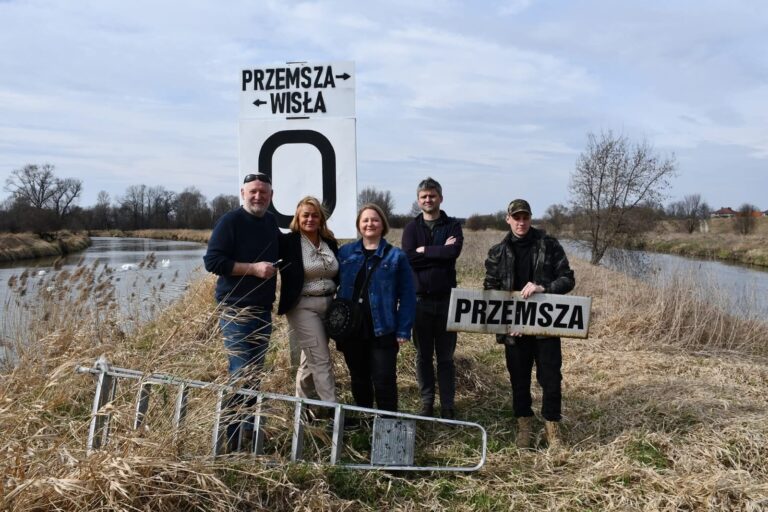
The aim: In the conditions closest to the original reconstruct the central, historic transport artety ‘ream’ in Poland.
The second aim of the raft is a film documentation of various aspects of life and history of the River.
To hold a ream, it means a tree, or to Take barges with Vistula to Gdańsk, it means ‘to pale’
„We decided, that the navigation on the rivers of Our Kingdom up and down with all kind of goods will be free to all people, of all positions, and we forbid to make any obstacles and to impost any duty on it” Jan Olbracht King JGM 1496
The ream existed ‘since always’ till the end of XIX century, and it was finished with the development of railroads. The ‘gold business’ had began in 1447, when the Parliament in Piotrkow passed the Act on Free Navigation on the Vistula River.
In that times, the Vistula River was on the territory of the Republic of Poland and her initial part was in Silesia, which was also economically dependent on Poland. The best example here is the career of the Kopernik family. The family of the astronomer was from Silesia. They were running a trade with copper. Because of the business the astronomer’s father settled along the Vistula – in Cracow, where the business was profitable. In 1454 Kopernik – senior, went to Gdańsk with the Vistula River for the business reasons. When he saw the possibilities of the River he moved to Toruń – an important trans-shipment harbor. The desired Peace Treaty in Toruń came (1466), and it connected the lower bank of the River with Gdańsk to Poland. The businesses started to develop.
In those conditions Mikołaj Kopernik junior was born (1473). At the beginning he was going to school in Królewiec, but later he went up with the River to study in Cracow. In 1510 he settled in Frombork near the Vistula Bay. This example superbly shows the migration and significance of the Vistula River in the history of Poland. During Kopernik’s life an export of grains with the River had grown from 5573 łaszt (the messure currency of that time period) in 1491 to 10 000 łaszt in 1539. Twenty years after the death of the astronomer the export was 66 007 łaszt.
It was the Vistula who forced the necessity for the reform of the currency in 1528 for the reason of unifying the currency in trade with Royal Prussia after the Feudal Tribute. For the necessities of that reform Kopernik who was a member of Prussian Parliament at that time, created ‘the theory of worse currency’. The trade on the Vistula River was smoothly served by a network of bank houses, which prospered successfully from the trade as well as the merchants who were drifting the grains and grange owners.
The Powerful Kingdom had to have a skilful diplomacy, and this couldn’t exist without an efficient post. The regular post was created by king Zygmunt August in 1558 to carry letters to Venice – because of that an important route was the Vistula River. The part of that post in West-European diplomacy was sailing first from Cracow, later from Warsaw with Vistula River and then through Baltic sea. In 1583 the royal mail from Gdańsk to London and Amsterdam needed from two to three weeks to reach the destination. To Spain – three months. With this route Dantyszek - the proficient diplomat of Zygmunt the Old - was keeping close contacts with Erasm from Rotterdam.
It is worth mentioning about the strategic year in Polish history – 1596, when king Zygmunt II Waza moved his property to Warsaw using for this the Vistula River. The history calls it as the move of the capital.
The Vistula River had its greatest period of prosperity in the first part of SVII century, when it was serving the huge part of international trade of Republic of Poland, and the proportion between the value of export and import in Gdańsk was like 5:1. Only the grain which was drifted with the River was 250000 korc per year. The export from Gdańsk in 1641 was counted as 27 674 307 Prussian pennies, where 73,3% was grain trade. As long as the trade on Vistula River existed, Poland was a powerful country. When because of the wars Poland was not able to supply grain with the Vistula River, her power was tottering. After the fail of Republic of Poland and division of the Vistula River in 3 parts, the river lost its strategic merchant meaning. The word of raftsman from 1877 sounds bitterly:
“My God – says and old Korson Franciszek from Siedliszowice, a simple peasant, illiterate person – how big was that Poland?
You go after Cracow, they say, that it is Poland, you go further to Wołoń to Telatyn, the say, that it is Poland, you go after Bug river, it is also Poland. We sailed so long to Warsaw, also Poland, and we sail further ‘under the third king’, they say it is not the end. Mah, what those dam Lords had done, that for windfall that country had sold, and now they had sunk and beg a lot, as we do, as beggars we have to wander for the bread, and as if we are in Poland, but we need passports and hell knows what else, and apart from that in Poland chap in our language cannot bring down, cause no one with you decently will have a word (…) and if there were Polish reigns then everything would be different”
The conditions of the trade were not improved also by customs obstructions for the navigation, which were caused by the policy of the countries which capitals were not located by the Vistula River. Only the local trade was continued on the Vistula.
However the character of the waterway was appreciated by Polish, which is shown for example by the fact that the first steamship on the Vistula launched in Poland was built by the central financial institution of Polish Kingdom – The Polish Bank in the Mechanical Manufactory of those Bank (Warsaw 1849). In spite of the customs problems in XIX century the Vistula was alive. In 1836 in Cracow there were registered 600 ships and 2500 raftsmen (the population of Cracow Republic was 36000 people). In 1847 by the Vistula through the Kingdom were floated 2049 rafts, and 1241 barges, transporting “hard coal, onions, 61400 tubs of nuts, 203615 hundredweights of imports, herrings’ syrup and 98141 barrels of turpentine, floorboards, logs, 32669 three scores of eggs, woods, 144367 items of bricks”. At the same year smuggling on the Vistula near Cracow was estimated by Austrians for 1000000 thalers (!!!). In 1983 12196 ships flown near Warsaw. From the Kingdom to Prussia 1713 ships flown in. It is wort to notice that in those time there was a ‘coal road’ from Myslowice with Przemsza River, then with the Vistula to Cracow and further.
When Poland reconqered its independence general Haller before ‘marriage with the sea” gave a proclamation to citizens of Pomerania. He wrote “A new epoch opens for you, an epoch of new life and magnificencey of sew gold age of Zygmunts’ Family and Batorys’ Family, when the Vistula and our sea will become again a link between Poland and the whole world”. It could not be expressed easier the success of the new country and to stress the chances of the II Republic of Poland.
In the interwar period the navigation was operated by the navigation companionships: the sail company of Śląsk-Śandomierz, which was also operating on Przemsza, The Polish River Navigation “Vistula” from Cracow, “Lord Bydgoski” and “Spółdzielnia Wisła” from Bydgoszcz, “Lloyd” from Torun. In Free City of Gdansk the might was shipowner Johanes Ick. The lowest goods traffic was from Oswiecim to Cracow (54000 tonnes), and the biggest was on the route from Tczew to Przegelina (537000 tonnes). It was all with the formation of new communication artery, from which Polish were so proud that the often called it “The New Vistula”. It was a railway connection Silesia – Gdynia. The formation of “The New Vistula” was a great success of the young country but also the end of the epoch of the river transport on the Vistula. The Vistula passed her success into a good hands. Probably the last strategic transport on the Vistula was the usage of the barge for the evacuation of priceless collection of kings’ tapestries from Wawel on the 3rd September 1939.
It can be said that the Vistula paid her debt to Zygmunts, who carried so much about her and the Kingdom.